
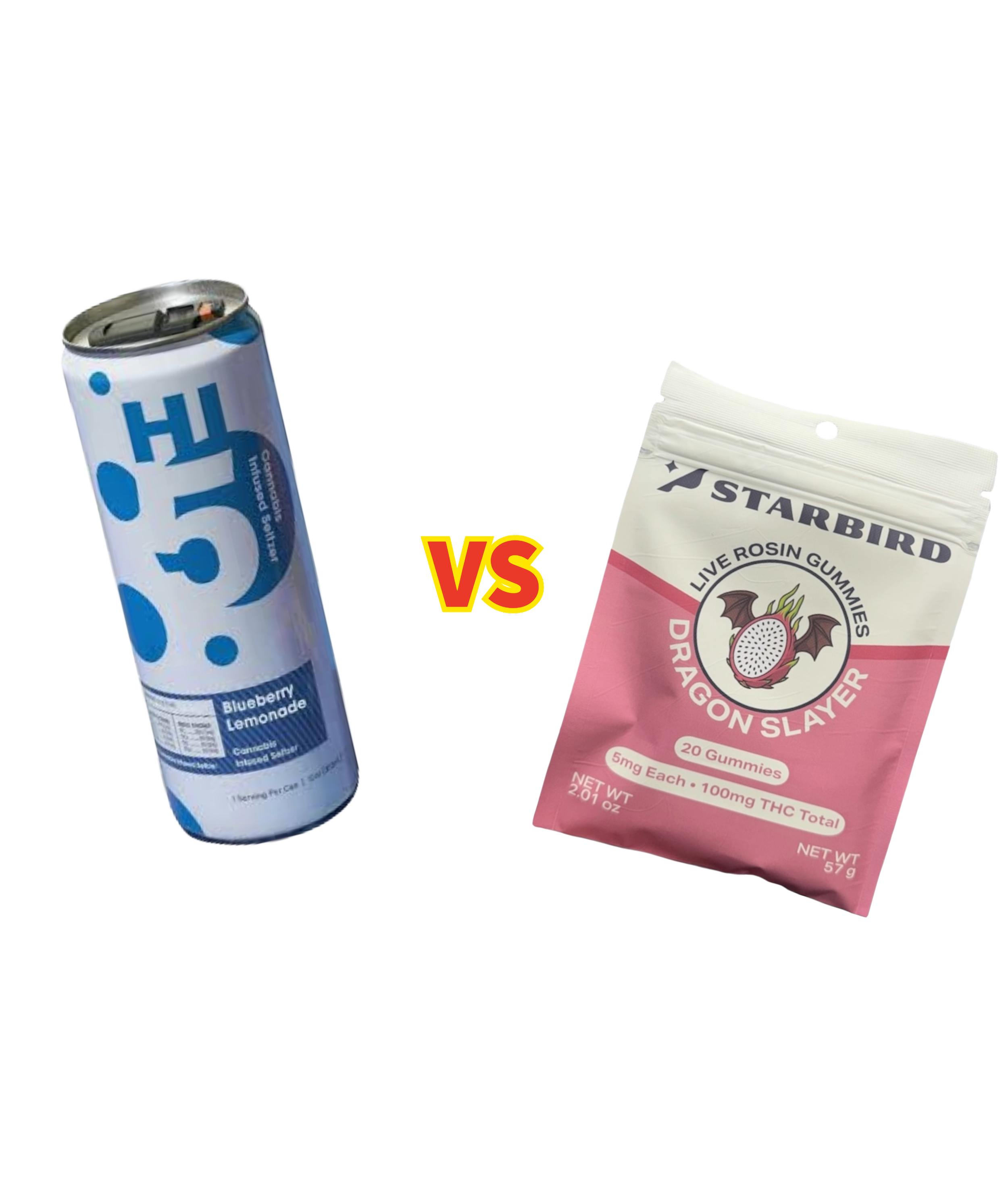
Cannabis Drinks vs Edibles: What’s the Difference?
Cannabis drinks and traditional edibles both deliver cannabinoids without smoking or vaping, but they are not interchangeable. A THC seltzer may be formulated for a faster onset and an easy sipping ritual, while a gummy, chocolate, or baked edible may take longer to feel and can remain noticeable for several hours.
The real comparison is not which category is universally better. It is which product has the dose, timing, ingredients, format, and experience that fit the occasion. If you are comparing THC drinks in Salem with cannabis edibles in Salem, start with the label rather than assuming every beverage or edible works the same way.
Quick Comparison: THC Drinks and Traditional Edibles
Onset: Some fast-acting THC drinks are designed to become noticeable sooner than traditional edibles. Other cannabis drinks can still take considerably longer. Gummies, chocolates, and baked edibles commonly have a delayed onset because they are swallowed and digested.
Duration: Both formats can last for several hours. A faster beginning does not guarantee a shorter ending, and residual effects can continue after the strongest part of the experience has passed.
Serving control: A single can may provide one clearly labeled serving, but not every container is one serving. Gummies and chocolates are often divided into individual pieces. Always compare THC per serving with total THC in the entire package.
Format: Drinks include seltzers, sodas, lemonades, teas, shots, and liquid enhancers. Traditional edibles include gummies, chocolates, chews, baked goods, mints, and other infused foods.
Best fit: Drinks may appeal to someone who enjoys sipping and wants a familiar beverage ritual. Solid edibles may be easier to carry, store, and portion, depending on the package.
What Are Cannabis Drinks?
Cannabis drinks are beverages formulated with THC, CBD, or a combination of cannabinoids. They can be carbonated or still, sweetened or unsweetened, ready to drink or added to another beverage as measured drops or a mix-in.
Because cannabinoids do not naturally mix well with water, manufacturers use different formulation methods to disperse them through a drink. Some products use emulsification or nanoemulsion technology and are marketed as fast acting. That phrase describes the formulation, not a promise that every person will feel the product at the same minute.
Our full THC drinks guide covers how these beverages are made, how to read their labels, and how the major drink styles differ.
What Are Traditional Edibles?
Traditional edibles are foods infused with cannabis extract. Gummies and chocolates are the most familiar examples, but the category also includes chews, mints, baked goods, capsules, and other ingestible formats.
After an edible is swallowed, THC passes through the digestive system and liver. Some of it is converted into 11-hydroxy-THC, an active metabolite that contributes to the distinct and sometimes long-lasting experience associated with oral cannabis. Drinks that are swallowed can also undergo this process, so it is inaccurate to say that every cannabis beverage bypasses the liver.
The THC edibles guide provides a wider look at edible formats, serving information, ingredients, and label reading.
THC Drinks vs Gummies
The most useful way to compare THC drinks and gummies is to place two actual labels side by side. A 5 mg drink and a 5 mg gummy contain the same labeled amount of THC, but formulation, absorption, food intake, tolerance, and individual body chemistry can still make the experiences feel different.
Gummies are compact and usually divided into individual pieces. Drinks create a longer sipping ritual, but sipping can make it harder to remember exactly how much has been consumed unless the container has a single serving or clear measurement marks. Neither format should be chosen by package size or flavor alone.
Shoppers focused specifically on gummies can compare serving sizes and formulations on our THC gummies near me page.
Onset Time: Drinks vs Edibles
Some fast-acting drinks may become noticeable in roughly 10 to 30 minutes. Other cannabis drinks can take 30 minutes to two hours or longer. Traditional gummies, chocolates, and baked edibles can also take two hours or more, especially when food, formulation, and individual response slow the process.
Those ranges are not a redosing schedule. Follow the product label and allow its full stated wait time before deciding whether to consume more. The THC drink onset time guide explains why timing changes from one beverage and one person to another.
Scientific reviews of oral cannabis show that route, formulation, dose, and individual variability all influence absorption. The NIH systematic review of oral cannabis and THC preparations provides useful research context without turning one study into a universal promise.
Duration: Drinks vs Edibles
Both drinks and solid edibles can remain noticeable for several hours. Traditional edibles are often associated with a longer experience than inhaled cannabis, but it is not safe to assume a fast-acting beverage will be finished quickly.
Dose, tolerance, food intake, formulation, and personal metabolism all matter. Plan around the possibility of delayed and lingering impairment. Do not drive, operate machinery, or schedule anything that depends on quick reaction time after consuming THC.
Dose and Serving Size
Read two numbers before consuming any edible product: THC per serving and total THC per container. They are not always the same. A bottle, can, chocolate bar, or gummy pouch can contain more than one serving even when the package looks small.
Also check whether the product includes CBD, CBN, CBG, or another cannabinoid. Ratios can change the product profile, but they do not cancel the intoxicating effects of THC. Our THC cannabinoid guide explains potency, product type, tolerance, and why a single number cannot predict the exact experience.
Flavor, Occasion, and Format
Format matters because it shapes how a product is used. A crisp seltzer may fit a slow social ritual, while a gummy can be easier to portion and store. A chocolate may suit someone who wants a richer flavor, while a still lemonade may appeal to someone who does not enjoy carbonation.
Think beyond flavor. Review sugar, calories, caffeine, allergens, storage instructions, cannabinoid ratio, and total servings. A familiar flavor does not make a THC product behave like an ordinary snack or soft drink.
Are Cannabis Drinks Fast-Acting?
Some are, and some are not. “Fast acting” usually refers to a formulation designed to disperse cannabinoids in water and support earlier absorption. It does not mean instant, identical, or risk-free.
Compare the manufacturer’s onset guidance with the serving instructions. If faster timing is the main reason you are considering a beverage, look for clear formulation and onset information rather than relying on the can design. Our guide to fast-acting edibles explains how these products differ from conventional ingestibles.
Which Is Better for Beginners?
Neither format is automatically better for a beginner. A clearly labeled, lower-dose product in a familiar setting is usually easier to evaluate than a product with multiple servings or unclear instructions.
Drinks can feel approachable because the format is familiar, but that familiarity can encourage someone to sip too quickly. Gummies can offer clear individual pieces, but delayed onset can lead to premature redosing. Tell one of our budtenders that you are new, ask them to show you the serving information, and choose a time when you do not need to drive.
How to Choose Between Drinks and Edibles
Start with five questions:
How much THC is in one serving and in the full package?
What onset and wait time does the label provide?
Do you want a beverage ritual or a compact solid format?
Are there ingredients, allergens, sugar, caffeine, or other cannabinoids to consider?
Can you consume and store the product legally and securely?
If local availability is the deciding factor, compare THC drinks near me with THC seltzers near me before visiting.
Explore Cannabis Drinks and Edibles at Starbird
At Starbird, we carry drinks and edibles across different flavors, formats, serving sizes, and cannabinoid ratios. Our team can help you read the label and compare products without pretending one option works the same way for everyone.
Adults must be 21 or older to purchase recreational cannabis in Massachusetts. Public consumption is prohibited, and cannabis cannot cross state lines. Review the Massachusetts Cannabis Control Commission adult-use laws before planning where you will use or transport a purchase. The CDC cannabis health and safety information, NIDA cannabis education, and FDA cannabis-derived product safety information offer additional research-based context.
FAQs About Cannabis Drinks vs Edibles
Are THC drinks stronger than edibles?
Not inherently. Compare THC per serving, total THC, cannabinoid ratio, and formulation. A drink can contain more, less, or the same amount of THC as a gummy or chocolate.
Do THC drinks hit faster than edibles?
Some fast-acting drinks are designed for an earlier onset than traditional edibles, but not every drink is fast acting and no timing is guaranteed. Follow the product label and allow the full stated wait time.
Are cannabis drinks considered edibles?
They are ingestible cannabis products and are often grouped with edibles, but beverages have their own formats, ingredients, and formulation methods.
Does a 5 mg THC drink feel the same as a 5 mg gummy?
The labeled THC amount is the same, but formulation, food intake, tolerance, metabolism, and pace of consumption can change the experience.
Can I mix THC drinks with alcohol?
We do not recommend it. Combining cannabis and alcohol can increase impairment and make effects harder to judge. Choose one, plan a safe setting, and do not drive.
How should cannabis drinks and edibles be stored?
Follow the package instructions and keep every cannabis product sealed, clearly identified, and locked away from children and pets. Refrigerate a drink only when its label requires it.